If you or your doctor is worried about cancer, you may want your answers really fast. One of the diagnostic tools that can provide faster results in this context would be the MRI for cancer. It is a sophisticated imaging technology that lets the doctors detect most of the ailments that affect the internal organs.
MRI is not just another scan, It is one of the best scans that can help the doctors to visualise the tissue tumours with an amazing accuracy.
In this blog, we will xplore what makes MRI special, which cancers it’s best at detecting, how to prepare yourself, and address those lingering questions that might be keeping you up at night.
What is MRI?
MRI stands for Magnetic Resonance Imaging. It is also called magnetic resonance, MR, or nuclear magnetic resonance (NMR) imaging. In theory, an MRI is a medical imaging test that creates detailed, cross-sectional pictures of the inside of your body without using radiation.
A CT is a single angle view of your internal organs through x-rays. In contrast, MRI is a three-dimensional picture of what’s happening inside. The MRI scan clearly shows the soft tissues like the organs, muscles, and tissues that are harder to visualize with other imaging methods.
How Does MRI Work?
Understanding how an MRI scan works should help you go through the scan without anxiety or stress. Here is how an MRI scan works –
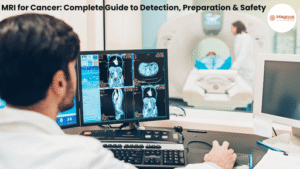
The MRI scanner is a large cylinder that consists of a powerful magnet. When you sleep on a table that slides through this cylinder, you will have a strong magnetic field that surrounds your entire body.
Your body consists of hydrogen atoms which is part of the water content in your body. The MRI machine uses a powerful magnetic force combined with a burst of radiofrequency waves to pick up signals from the nuclei of these hydrogen atoms. A computer converts these signals into images in black and white.
The machine creates multiple images and combines them to give a comprehensive view of the interal organs to give the doctors an insight into the scanned organ.
Can MRI Detect Cancer?
Yes, MRI can effectively detect cancer. In fact, doctors trust MRI as a more reliable option to diagnose cancer than the other imaging techniques like CT scan or X-rays.
There are several reasons that make MRI a powerful scan to detect cancer –
- Detailed imaging of soft tissues – MRI can create exceptionally clear images of the soft tissues. That would mean you can have a clear view of the tumours that other imaging techniques may fail to do.
- Size and location – MRI lets the doctors find the exact size and location of the tumour. It can be quite critical in the treatment.
- Staging of the cancer – It can also help find if the cancer has spread from the affected organ to the other areas. This is called staging and MRI can efficiently detect the stage of cancer the patient may be in.
- Monitoring treatment – Once your cancer treatment begins, MRI scans can be used to find the effect of the treatment on the cancer cells.
Even when MRI can detect cancer, it may still miss small tumours. That is why MRI is not solely used for diagnosing cancer. The images are used along with other confirmatory tests like biopsies, blood tests, and sometimes other imaging tests to confirm a cancer diagnosis.
What Kinds of Cancer Can MRI Detect?
MRI is quite capable and versatile when it comes to detecting multiple cancers.
Brain Cancer or Brain tumour
MRI is a gold standard in detecting brain tumour. The soft tissue images have been found to be incredible and when you use the dye, the images become all the more clearer. The MRI scan makes it extremely easy to differentiate the tumours from the surrounding healthy tissues.
Breast cancer
Doctors use specialised breast MRI scans to determine if the patient has breast cancer. The MRI can be valuable when the mammography results are not much clear. It can also be used for the evaluation of the damage.
Liver cancer
MRI can provide a very detailed inputs on the liver tumours. The scan also help find if the tumour has spread to the nearby blood vessels and other liver structures.
Prostate cancer
MRI scans are used extensively for the diagnosis of prostate cancer. It can help the doctors assess the extent of the tumour and helps them analyse the staging. This can be helpful in finding the size and location of the cancer within the prostate gland.
Spinal cancer
MRI scan is considered to be the reliable tool to detect cancers that affect the spinal cord and surrounding areas. The ability of the scan in detecting the soft tissues makes it a really efficient tool for the doctors.
Pelvic cancer
MRI has been an excellent scan technique for detecting pelvic cancers. The scan can detect multiple cancers that affect organs like bladder, uterus, ovaries, and other pelvic structures.
Rectal and Colon Cancer
MRI scan can help detect the colorectal cancers and also let the doctors understand the staging. The scan can give complete information on how deeply tumors have invaded surrounding tissues. This information is much crucial for treatment planning.
Lung cancer
MRI scan is not used as the first line test for lung cancer. However, it can give the doctors detailed information on the stage of the cancer. The scan also helps the patients to determine if the cancer has spread to the spinal cord and the brain.
It may, however, be noted that MRI may not be equally effective in detecting every type of cancer. Bone cancers and blood cancers cannot be detected using MRI scan. This is primarily because these cancers do not produce tumours.
How Should I Get Ready for an MRI?
Well, you have a good news. Preparing for the MRI for cancer need not be a stressful task.
Pre-appointment
MRI scan is painless and non-invasive. Thus it does not need any special preparation. Most MRI scans are done on an outpatient basis.
You may go through metal screening. That means the technicians will aslk you if you have nay metals in your body.
Metal objects that can be a problem include:
- Pacemakers or implantable defibrillators
- Brain aneurysm clips
- Cochlear (ear) implants
- Metal coils in blood vessels
- Surgical clips, staples, screws, plates, or stents
- Artificial joints
- Metal fragments (shrapnel)
- Artificial heart valves
You may need to go through an X-ray to rule out any metal objects in your body.
On the day of MRI
You will be asked to wear a loose cloth on the day of the scan. You can even wear your own clothes if they do not contain any metal.
Remove all the metals that include jewelry, hair clips, watches, body piercings, coins, and keys.
You can continue taking your medications unless your doctor specifically asks you not to.
Claustrophobia Concerns
If you are anxious about being in a confined space, tell your medical team beforehand. They can:
- Show you the machine before your scan
- Talk you through what to expect
- In some cases, provide sedation to help you relax
- Possibly use an open MRI machine, which is less restrictive (though images may not be as clear)
Special Situations
- Pregnancy: MRI cancer detection is generally safe during pregnancy, but make sure to tell your doctor if you’re pregnant. It’s usually avoided during the first 12 weeks unless medically necessary.
- Kidney Problems: If you have severe kidney problems or are on dialysis, gadolinium contrast dye is rarely used because it can cause complications.
Conclusion
MRI is one of the powerful tools in the hands of the doctors in detecting and monitoring the cancer. It can take clear images of the soft tissues – making it an invaluable tools in diagnosing brain, breast, liver, prostate, spinal, pelvic, and other cancers.
If your doctor has recommended an MRI, take it as a positive sign. It means they’re using the best available technology to get you answers and develop an effective treatment plan if needed. And remember: having an MRI won’t increase your cancer risk. It might very well help detect cancer early, when treatment options are most effective.
FAQs
Can cancer be missed by an MRI?
Yes, it is possible that MRI may miss a cancer. MRI can miss small tumors or produce unclear images. The doctors may use additional tests to conform any possible signs of cancer.
What can I expect during an MRI?
You will lie on a table that slides inside a large MRI scan machine. The strong magnetic field around your body will create images on a computer screen. The machine makes loud noise, so you will be asked to wear ear plugs.
How long does an MRI take?
Most MRI scans take around 45 to 60 minutes to complete. However, depending on which body parts are being scanned, the scan can also take right from 15 minutes to 2 hours.
Do MRIs cause cancer?
No. MRI does not use radiation and studies have not shown that MRI causes cancer. You can have multiple MRIs without concern about developing cancer.